
Down Another Rabbit Hole
Following a New Clue to the Life and Legacy of Mr. Johns Hopkins

One thing I can be sure of when conducting new research: It will inevitably take me down a fascinating rabbit hole if I’m willing to follow the trail. Today, I had to set aside my intended work to do just that, after happening upon a discovery that was worth sharing with you!
I’m supposed to be putting the finishing touches on an article that explains the remarkable moment in 1895 when Frances Ellen Watkins Harper — the renowned abolitionist, suffragist, poet, and temperance advocate — returned to Baltimore to join a celebration that marked the opening of a the new Johns Hopkins Hospital Colored Orphan Asylum. Some of you may have heard me speak about this at the Baltimore Museum of Art for the annual Donald V. Bentley Memorial lecture, sponsored by the Billie Holiday Center for Liberation Arts.
The Hopkins Orphan Asylum was founded in 1875, one facet of Mr. Hopkins’ bequest (the others were a hospital and an university), but it was not the first such institution established to support Black children who were without parents or otherwise with family unable to provide for them. The Oblate Sisters of Providence, a Black-led Catholic order, had been doing this work since the 1860s. So had Baltimore’s Shelter for Orphans of Colored Soldiers and Friendless Colored Children, established in 1868. I knew too little about this latter organization and so dove into their annual reports.
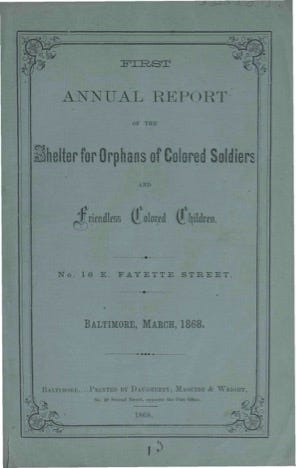
I wasn’t but a few pages in when, scanning the names of the shelter’s board of counsellors, I discovered Mr. Johns Hopkins.1 He was there, among a list of distinguished men — many of them associated with the Quaker community — who had organized with the aim of “lending a helping hand to those doubly destitute, because shut out from so many avenues of aid and sympathy open to those of the fairer hue.”2 The enterprise had begun in 1866 and Mr. Hopkins himself was credited was contributing $500.00 to the effort.
Fresh details about the origins of the Johns Hopkins Hospital Colored Orphan Asylum — and Mr. Hopkins — came into view. Though its work was later carried out by hospital trustees after his death in 1873, the origin story of the Hopkins asylum may lie in the immediate post-Civil War period and Mr. Hopkins’ gradual turn toward philanthropy, including that directed toward Black Baltimoreans. The historiography helps connect the dots. Quaker historian Edward Needles Wright explains that the Shelter for Orphans resulted, in part, from a merger with the slightly older “Friends’ Association in Aid of Freedmen.”3
The thing about rabbit holes is that one often leads to another. Perhaps additional clues about Mr. Hopkins’ philanthropic turn lie in the details of the “Friends’ Association in Aid of Freedmen Records” held at the Swarthmore College Special Collections. As has long been the case, when aiming to better understand Mr. Hopkins and his journey from enslaver and capitalist to patron and philanthropist, the record is slim. And still, today we are continuing to assemble new clues that go toward solving the mysteries that surround his life and his work.
For now, I’ll get back to the matter at hand — that essay about Frances Ellen Watkins Harper!
À bientôt.
— MSJ
First Annual Report of the Shelter for Orphans of Colored Soldiers and Friendless Colored Children (Daugherty, Maguire & Wright, 1868). Mr. Hopkins remained on the shelter’s board of counsellors at least through 1869. See, Second Annual Report of the Shelter for Orphans of Colored Soldiers and Friendless Colored Children (Daugherty, Maguire & Wright, 1869.)
First Annual Report of the Shelter for Orphans of Colored Soldiers and Friendless Colored Children (Daugherty, Maguire & Wright, 1868).
Edward Needles Wright, “John Needles (1786-1878): An Autobiography,” Quaker History 58, no. 1 (Spring 1969): 3-21.
Thank you for your scholarship. I guess I had gained a rather dim view of Mr. Hopkins after learning about his enslavement of people, the discriminatory past of Johns Hopkins Hospital, the Henrietta Lacks theft, and the Hopkins faculty and staff I have represented in discrimination cases as a lawyer, but your scholarship shows there was more to Mr. Hopkins than all of that. God bless those rabbit holes!